

The quick answer on your used car loan
If you’re financing a used car in the UAE right now, go fixed-rate for cars five years or older, and consider variable only on newer models you plan to pay off within two years. Car age and a documented service history matter more to your approval than most people realise — and with fuel costs up about 16% since October, locking in a predictable monthly payment makes budgeting a lot smoother.
The short version
- Fixed rate: predictable payments, best for cars over five years old or loans longer than three years.
- Variable rate: starts lower, but only worth the risk on newer cars with short loan terms (under two years).
- Car age matters: most UAE banks won’t finance cars older than 10 years — and older cars get higher rates.
- Service history matters: cars without documented history sell for about 14% less on CarSwitch, and banks see them as riskier collateral.
- Get inspection-verified: a full inspection report strengthens your loan application and can help you negotiate a better rate.
What “fixed” and “variable” actually mean for a used car loan
A fixed-rate used car loan locks your interest rate for the entire term. Your monthly payment stays the same from month one to the last. Most UAE banks offer fixed rates on used car finance between roughly 3% and 5% flat, depending on the car’s age and your salary.
A variable rate (sometimes called a “reducing balance” rate) is tied to the Emirates Interbank Offered Rate, or EIBOR. When EIBOR moves, your payment moves with it. Right now, variable rates typically start lower than fixed — but they can climb.
Here’s the practical difference. On a three-year loan of AED 80,000:
- At a 4% flat fixed rate, you pay about AED 2,489 a month. That number won’t change.
- At a variable rate starting around 3%, your first payment is lower — roughly AED 2,356. But if EIBOR rises by even half a percent, you’re back above the fixed option within a year.
How car age affects your used car loan approval
Banks look at the car as collateral. The older it is, the less it’s worth to them if you stop paying. Most UAE banks draw a hard line at 10 years — if the car is older than that at the end of the loan term, they won’t finance it at all.
That means a 2018 model can still get a five-year loan today, but a 2016 model is likely capped at three years. And shorter terms mean higher monthly payments.
On CarSwitch, we see the age-price relationship clearly. A 2018 BMW 318i is listed around AED 40,500 with about 116,000 km on the clock. A 2017 of the same car drops to around AED 31,500 (CarSwitch listings data, July 2026). That one year of age costs you about AED 9,000 in resale value — and it also costs you loan flexibility.
“Banks price the car’s future value, not today’s value. A well-maintained four-year-old car with full service records is a much smoother approval than a six-year-old one with gaps.”
Kamel Abbou, Country Manager, UAE, at CarSwitch
Why service history changes the numbers
This one surprises people. A car’s documented service history doesn’t just affect the price you pay — it affects the loan you can get.
Across our listings, cars with no documented service history sell for about 14% less than comparable cars with full records. That’s not a small gap. On an AED 80,000 car, that’s roughly AED 11,000 in lost value.
Banks notice this too. When the collateral — your car — is worth less because its history is incomplete, the bank takes on more risk. That means a higher rate, a larger down payment, or both. Some lenders require 30% down on cars without records, versus 20% on cars with a clean history.
This is one reason why buying an inspection-verified used car in Dubai matters beyond peace of mind. A 200-point inspection report gives both you and the bank a clear picture of the car’s condition.
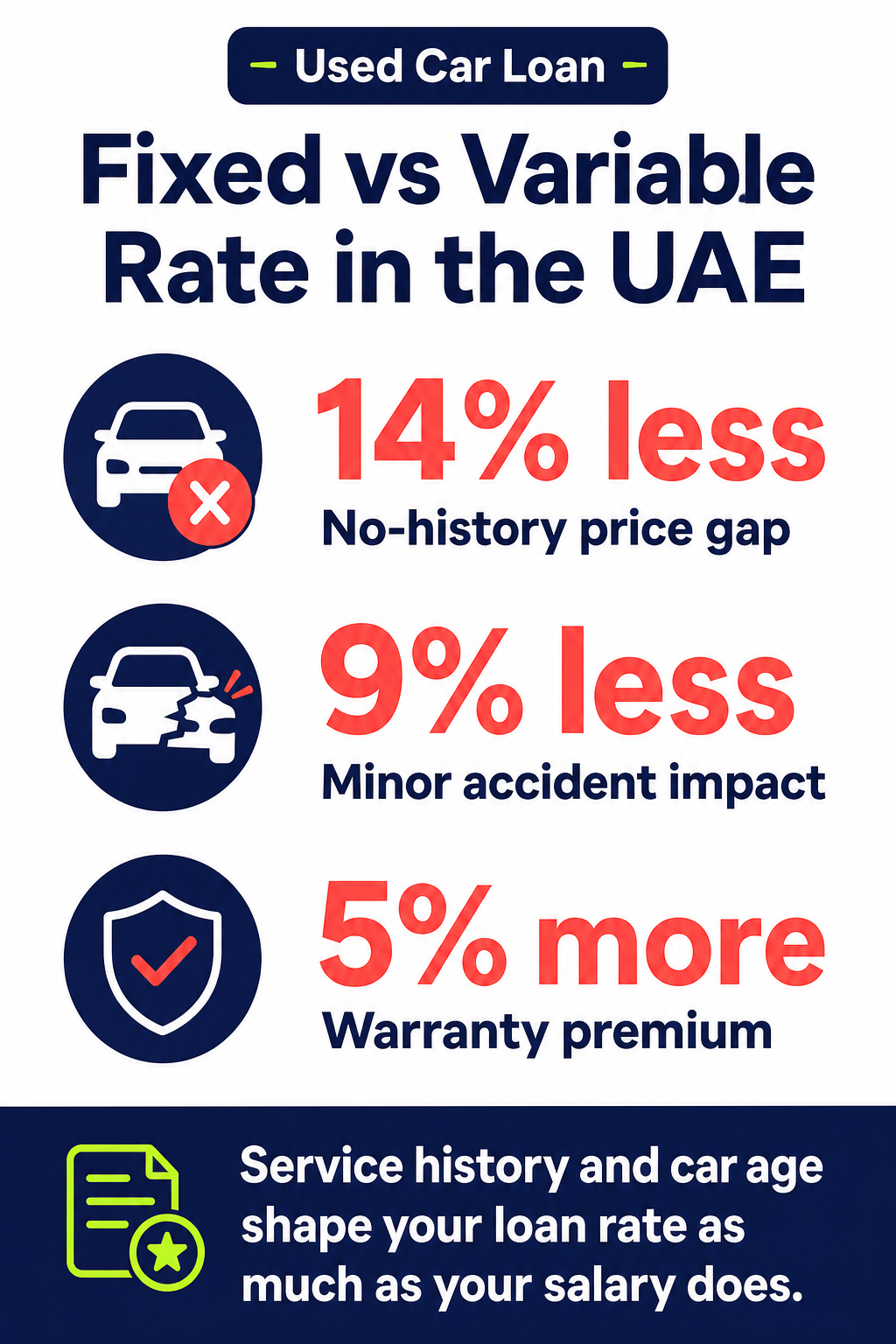
Cars with no service history sell for 14% less than those with full records.
A minor accident on record reduces value by about 9%.
Cars still under manufacturer warranty carry a 5% price premium.
Source: CarSwitch listings data, July 2026
Fixed vs variable: when each makes sense
Go fixed when:
- The car is five years old or more. You’re already paying a higher rate because of the car’s age. Adding rate uncertainty on top makes budgeting harder.
- Your loan term is three years or longer. More time means more chances for EIBOR to move against you.
- You’re stretching your budget. With fuel up 16% and daily costs climbing, a surprise payment increase is the last thing you need.
Consider variable when:
- The car is under three years old. Banks see newer cars as stronger collateral, so you get better variable rates to start with.
- You plan to pay it off in under two years. Less time exposed to rate changes.
- You can absorb a payment increase of 10–15%. If an extra AED 200–300 a month wouldn’t hurt, the lower starting rate can save you money overall.
What UAE banks typically look at
| Factor | Impact on loan | What we see on CarSwitch |
|---|---|---|
| Car age (under 5 years) | Full term available, lower rate | 2022 Audi A3: AED 89,995 |
| Car age (5–8 years) | Shorter term, slightly higher rate | 2018 BMW 318i: AED 40,500 |
| Car age (8–10 years) | Max 2–3 year term, highest rates | 2016 Audi Q5: AED 29,000 |
| No service history | Higher down payment, higher rate | 14% lower resale value |
| Minor accident on record | Some banks decline, others add margin | 9% lower resale value |
| Manufacturer warranty active | Smoother approval, sometimes lower rate | 5% price premium |
How to set yourself up for a smoother approval
- Pick the right age car. Three to five years old is the sweet spot — you save significantly versus new (a 2022 Audi A3 costs about half its new price) but banks still see it as solid collateral.
- Insist on service records. If the seller can’t produce them, that’s not just a red flag for you — it’s one for the bank.
- Get an inspection report. Banks in the UAE increasingly accept third-party inspection reports as supporting documents. CarSwitch’s 200-point inspection gives both you and the lender confidence.
- Shop the rate, not just the car. Get quotes from at least two banks before you commit. The difference between 3.5% and 4.5% flat on an AED 80,000 loan over three years is about AED 2,400 in total interest.
- Consider your total monthly cost. With fuel prices higher, car installment payments aren’t the only line item. Factor in insurance, fuel, and servicing before you decide how much to borrow.
The bottom line
If you want certainty — and with fuel and living costs where they are, most buyers do — a fixed-rate used car loan is the safer play on anything older than three or four years. Variable rates can work, but only if the car is newer, the term is short, and you have room in your budget if payments rise.
Whatever you choose, a car with full service history and an inspection report behind it gives you a stronger hand — both at the bank and at the negotiating table.
Browse inspection-verified used cars in Dubai, or check used cars for sale in Abu Dhabi. Every car comes with a detailed inspection report and transparent pricing — so you know exactly what you’re financing. Ready to sell your car and upgrade? We handle the details.
For most buyers, fixed is the safer choice — especially on cars over five years old or loans longer than three years. Variable rates start lower but can rise with EIBOR, making your payments unpredictable.
Most UAE banks won’t finance a car that will be older than 10 years at the end of the loan term. Older cars get shorter terms and higher rates because banks see them as weaker collateral.
Yes. Cars without documented service history sell for about 14% less, which means the bank’s collateral is worth less. That often leads to a higher down payment requirement or a higher interest rate.
Typically 20% for cars with clean records and full service history. If the car has no service records or a history of accidents, some banks ask for 30% or more.
