

The quick answer on accident history and used cars in Dubai
Shopping for used cars in Dubai? If a car has a minor accident on record, it’s typically listed for about 9% less than the same car with a clean history. That’s real money — on a car listed at AED 100,000, you’re looking at roughly AED 8,500 off. Know how to read the accident report, and you can either negotiate smarter or walk away before you waste a weekend.
The short version
- A minor accident history knocks about 9% off the listed price compared to a clean record (CarSwitch listings data, July 2026).
- A major accident record doesn’t automatically mean a bigger discount — read below for why.
- Ask for the inspection report before you visit. Every car on CarSwitch is inspection-verified.
- Use accident history as a negotiating tool, not a reason to panic.
- If the report shows structural or frame damage, walk away.
What the numbers actually show on used cars in Dubai
Across the cars we’ve listed on CarSwitch, a minor accident history is tied to about a 9% lower asking price compared to identical cars with no accident history at all. That figure comes from hundreds of listings, so it’s solid.
Here’s what’s surprising: cars flagged with a major accident don’t show a consistent bigger drop. The number we’ve seen — roughly 5% higher, not lower — is based on far fewer listings and likely reflects survivors: the major-accident cars that do get listed tend to be higher-value models that were professionally repaired. Don’t read that as “major accidents are fine.” Most major-accident cars never make it back to market at all.
“Buyers in Dubai are more informed than they were five years ago. They check the accident report before they even book a viewing, and they negotiate accordingly.”
Kamel Abbou, Country Manager, UAE, at CarSwitch
| Accident History | Price Effect vs Clean Record | Data Confidence |
|---|---|---|
| No accident | 0% (baseline) | High (1,000+ listings) |
| Minor accident | -9% | High (250–999 listings) |
| Major accident | +5% * | Indicative (100–249 listings) |
* Small pool of surviving listings, mostly higher-value cars. This does not mean major accidents increase value.
How to read an accident report — step by step
Every inspection-verified car on CarSwitch comes with a report. Here’s what to look at first.
1. Check the accident classification
Minor usually means cosmetic or panel damage — a bumper respray, a fender replacement, a door ding that was fixed. The car’s structure wasn’t touched. These are common in Dubai traffic and don’t necessarily affect how the car drives.
Major means the car was in a serious collision. Think airbag deployment, frame straightening, or structural welding. This is where you need to be much more careful.
2. Look at what was repaired
The report will list which panels were repainted, replaced, or repaired. A repainted bumper? That’s normal. Multiple panels repainted on the same side? That’s a side impact — ask more questions.
3. Check for structural or frame notes
This is the line that matters most. If the inspection flags frame damage, misaligned panels, or signs of structural repair, that car will be harder to resell later and may have hidden mechanical issues. Walk away.
What this means for resale down the road
That 9% discount doesn’t just apply when you’re buying. It applies again when you sell your car. A minor accident follows the car through every future transaction. So if you buy a car with a minor history, price in the fact that your next buyer will want a similar discount.
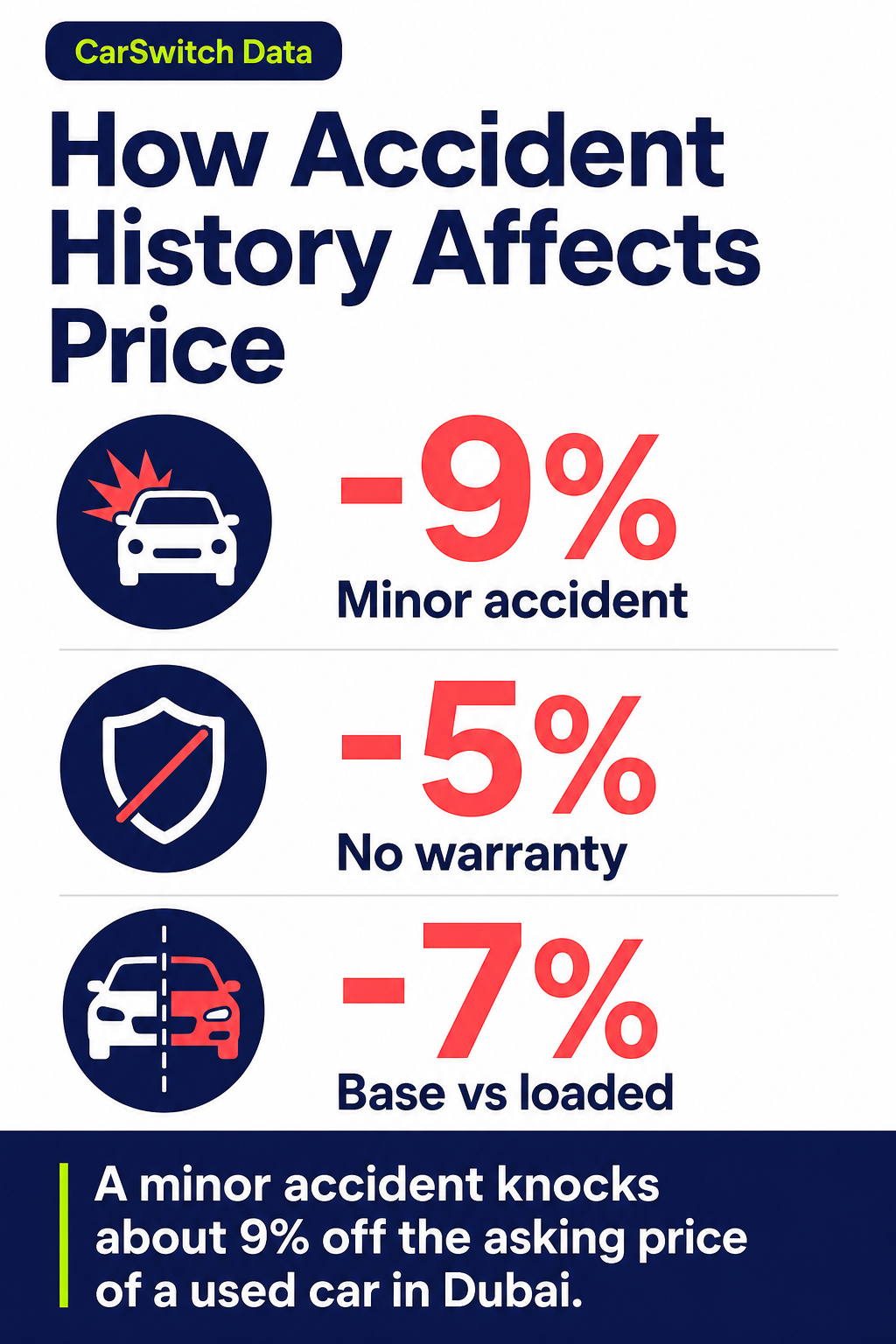
For context, other things that move the price on used cars: a car with no manufacturer warranty left typically lists for about 5% less than one still covered. And a base-spec car lists for about 7% less than a fully loaded version. Accident history sits right in that range — meaningful, but not a dealbreaker if the price is right.
Minor accident history: -9% vs clean record (high confidence, 250–999 listings)
No manufacturer warranty: -5% vs warranty intact
Base spec vs fully loaded: -7%
How to use this when you negotiate
If you’ve found a car you like and it has a minor accident on record, here’s how to approach it.
Don’t pretend you didn’t see it. The seller knows it’s there. Bring it up directly: “I see there’s a minor accident on the report. I’d like to talk about the price.”
Reference what clean versions cost. Browse used cars in Dubai for the same model and year with no accident history. That gives you a concrete number to point to.
Be reasonable. If the car is already priced about 9% below comparable clean listings, the discount may already be baked in. Check before you push further.
When to walk away
Not every accident car is worth your time. Here are clear signals to move on:
- The report mentions frame or structural repair.
- Multiple major panels were replaced — not just repainted.
- The seller can’t explain what happened or refuses to share the full report.
- The price isn’t meaningfully lower than clean alternatives.
If you’re looking at cars under AED 25,000, be especially careful. At lower price points, a post-accident repair bill can quickly exceed what you saved on the purchase.
The bottom line
A minor accident on the record isn’t the end of the world. It’s a pricing factor — about 9% off, based on what we’ve seen across hundreds of CarSwitch listings. Know what you’re looking at in the report, price in the future resale hit, and negotiate with real numbers instead of guesses.
Every car on CarSwitch is inspection-verified by real people. You’ll know exactly what you’re getting before you commit. Browse inspection-verified used cars in Dubai and check the accident history for yourself.
Based on CarSwitch listings data, a minor accident history is tied to about a 9% lower asking price compared to the same car with no accident record. On a car listed around AED 100,000, that’s roughly AED 8,500.
Not necessarily. A minor accident usually means cosmetic damage like a bumper respray or fender fix. The key is reading the inspection report carefully. If there’s no structural damage, the car can still be a solid purchase — especially if the price reflects the history.
Minor typically covers cosmetic or panel damage that didn’t affect the car’s structure. Major means a serious collision — think airbag deployment or frame repair. Most major-accident cars never make it back to market. If a report flags structural damage, it’s safer to walk away.
Every car on CarSwitch comes with an inspection report that flags accident history, panel repairs, and structural condition. You can review this before you visit. For additional records, you can also check with the RTA or request a vehicle history report.
