

When used cars in Dubai cost the least — and the most
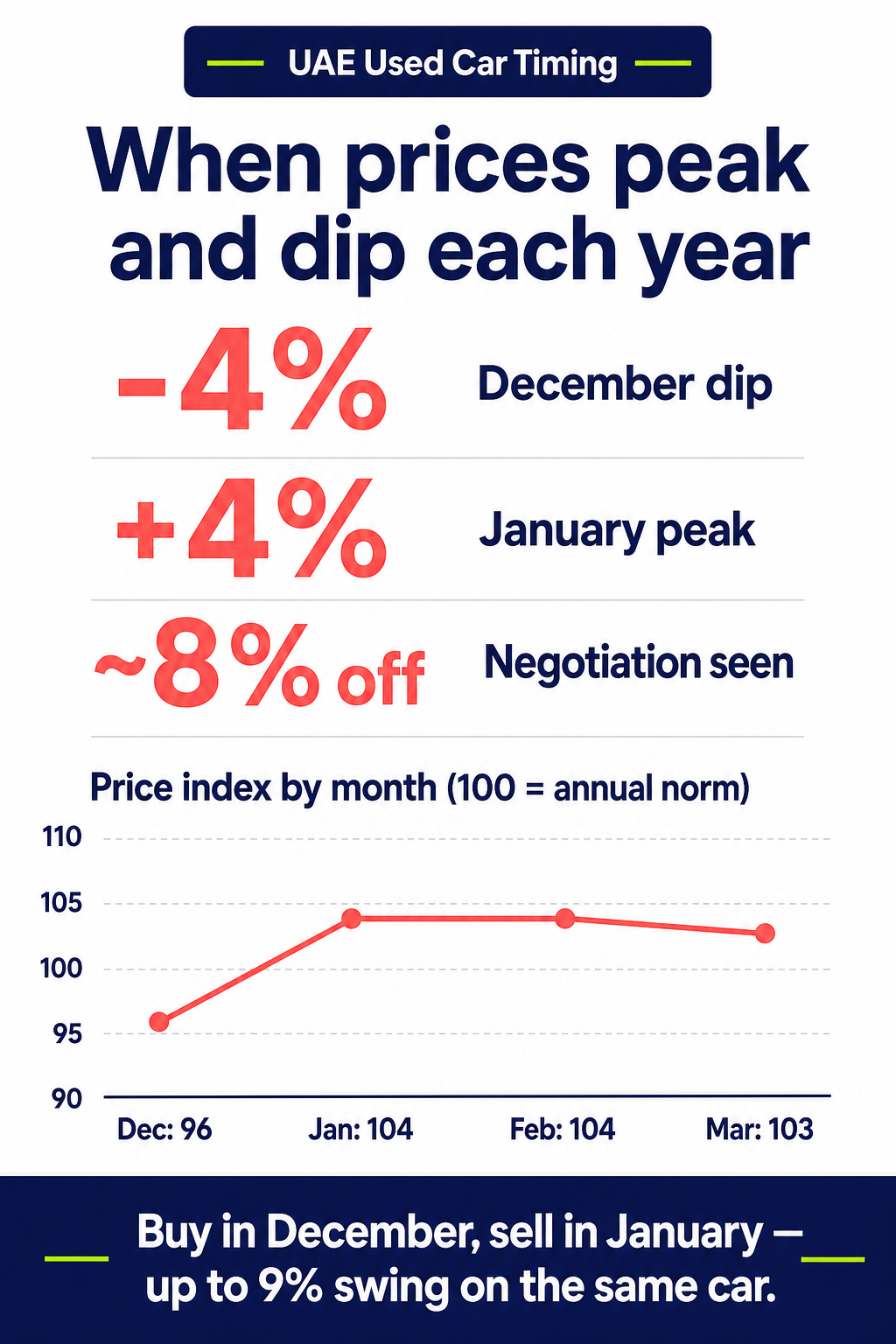
If you’re shopping for used cars in Dubai, December is your month. Prices drop about 4% below the yearly norm. January flips the other way — prices climb roughly 4% above it. That’s nearly a 9% swing between the cheapest month and the priciest, on the same car. Time it right, and the calendar does some of the negotiating for you.
The short version
- December has the lowest used car prices in the UAE — about 4% below the annual norm (CarSwitch listings data, July 2026).
- January is the most expensive month — about 4% above the norm.
- Prices ease downward from March through December, then spike in the new year.
- We’ve seen buyers negotiate about 7–8% off asking across all price ranges — more on cars listed under AED 30,000.
- Selling? List in January or February, when prices are highest.
The month-by-month price picture for used cars in Dubai
We tracked like-for-like prices across all CarSwitch listings to see how the same type of car is priced differently depending on the month. Here’s what the first quarter looks like — and the December low that precedes it.
| Month | Price index | Difference vs annual norm |
|---|---|---|
| December | 96 | -4% |
| January | 104 | +4% |
| February | 104 | +4% |
| March | 103 | +3% |
December sits at the bottom. January jumps to the top. February and March stay elevated before the market gradually cools through the rest of the year.
Why December is cheaper and January is not
Two things happen at once in December. Sellers want to close before the year ends — some are clearing personal finances, some are offloading fleet cars. Buyers, meanwhile, are spending on holidays and travel, not cars. More supply, fewer buyers. Prices dip.
January reverses the equation. New-year budgets kick in. Tax residency resets matter for some expats. Demand surges. Sellers know it, and they price accordingly.
“December is when sellers are most motivated and buyers are most distracted. If you’re paying attention, that’s when you get fair value.”
Imad Hammad, CEO and co-founder of CarSwitch
What this means if you’re buying
On a car listed around AED 80,000, a 4% seasonal dip saves you roughly AED 3,200 — before you’ve even started negotiating. Combine that with the negotiation room we’ve seen on cars in this price range, and your total saving grows.
Speaking of negotiation: across all price ranges, we’ve seen about 7–8% come off the asking price. On cars listed under AED 30,000, the discount tends to be wider — closer to 9%. On cars above AED 200,000, it’s tighter, around 5%.
December price index: 96 (4% below annual norm)
January price index: 104 (4% above annual norm)
Overall negotiation discount observed: 8%
So buying a car worth about AED 80,000 in December instead of January — and negotiating a reasonable discount — could mean keeping roughly AED 10,000 in your pocket compared to paying full asking in the priciest month.
What this means if you’re selling
The flip side is straightforward. If you want the strongest price for your car, list it in January or February. Buyer demand is highest, and listing prices reflect that — about 4% above the annual norm.
Listing in December isn’t wrong, but know that the market is softer. You’ll likely face more negotiation and wait longer. If you can hold until January, the calendar works in your favour.
Does city matter?
Not as much as timing does. Like-for-like prices in Dubai, Abu Dhabi, and Sharjah are all within about 2% of the national norm. That’s not enough to justify driving across emirates for a better price. Shop wherever is convenient.
Pair timing with the right car and the savings stack up
Seasonal timing matters more on cars where the used-vs-new gap is already large. A six-year-old BMW 5 Series, for example, lists for around AED 80,000–84,000 on CarSwitch — roughly 70% less than its original showroom price. Buy that car in December instead of January, negotiate well, and you’re compounding savings on top of savings.
Similarly, a four-year-old Audi A3 lists around AED 90,000 — about half of what it cost new. The car has already taken its biggest value hit. You’re buying the flat part of the curve, at the cheapest time of year.
A few practical tips for timing your purchase
- Start browsing in November. By the time you’ve shortlisted, test-driven, and had the car inspection-verified, it’ll be December — right in the sweet spot.
- Don’t wait until mid-January. Prices jump fast at the start of the year. If you miss December, late November is your next-best window.
- Negotiation still matters. Seasonal pricing and negotiation are separate levers. Even in December, come prepared with comparable listings so you can negotiate from a position of knowledge.
- Check the inspection report. Timing gets you a better price. An inspection-verified listing tells you whether the car deserves that price. A minor accident history, for instance, tends to knock about 8–9% off what a clean-history car would list for.
Find your next car at the right time
Whether you’re buying or selling, knowing when prices shift gives you a real edge. Browse 2,400+ inspection-verified used cars in Dubai on CarSwitch — every listing comes with transparent pricing and a detailed inspection report. Real people are here to help you through the rest.
December. Based on CarSwitch listings data, prices in December run about 4% below the annual norm. January is the priciest month, sitting about 4% above it.
It depends on the car and the price range. On cars listed under AED 30,000, we’ve seen closer to 9% come off. On cars above AED 200,000, it’s been closer to 5%. Across all ranges, it’s been around 7–8%.
The price difference between Dubai, Abu Dhabi, and Sharjah is only about 2% like-for-like. That’s not enough to change your plans — shop wherever is most convenient.
January and February. Prices run about 4% above the annual norm in those months, so buyers are paying more and demand is strongest.
