

Insuring a used car in Dubai comes down to four things: pick the right type of cover, know how your car’s history affects the premium, gather your documents before you start, and compare quotes from at least three insurers. That’s the whole process — here’s how each part works.
The short version
- Comprehensive cover costs more but is worth it on cars worth over AED 50,000. Third-party is fine for older, lower-value cars.
- A car with a minor accident on its record is worth roughly 9% less — and that lower insured value means a lower premium, but also a lower payout.
- You need your Emirates ID, vehicle registration card, and driving licence. That’s it.
- No-claims years, voluntary excess, and bundling with your bank can cut premiums noticeably.
- Get your car inspection-verified before you insure — some insurers offer better rates on cars with a documented condition report.
Two types of cover for used cars in Dubai
Every car on Dubai’s roads needs insurance. The law requires at least third-party cover, but you have two real options.
Third-party liability covers damage you cause to other people and their property. It doesn’t cover your own car. Premiums start from around AED 500–800 a year. It makes sense for older cars that have already lost most of their value — if a 12-year-old sedan is only worth AED 15,000, paying AED 3,000 a year for comprehensive cover doesn’t add up.
Comprehensive cover protects your car too — theft, fire, accidents, natural damage. For used cars in Dubai that still hold real value, this is usually the smarter choice. Premiums typically run between 2.5% and 4% of the car’s insured value each year.
How your car’s history changes what you pay
Insurers care about two things above all: the car’s current value and its risk profile. Accident history affects both.
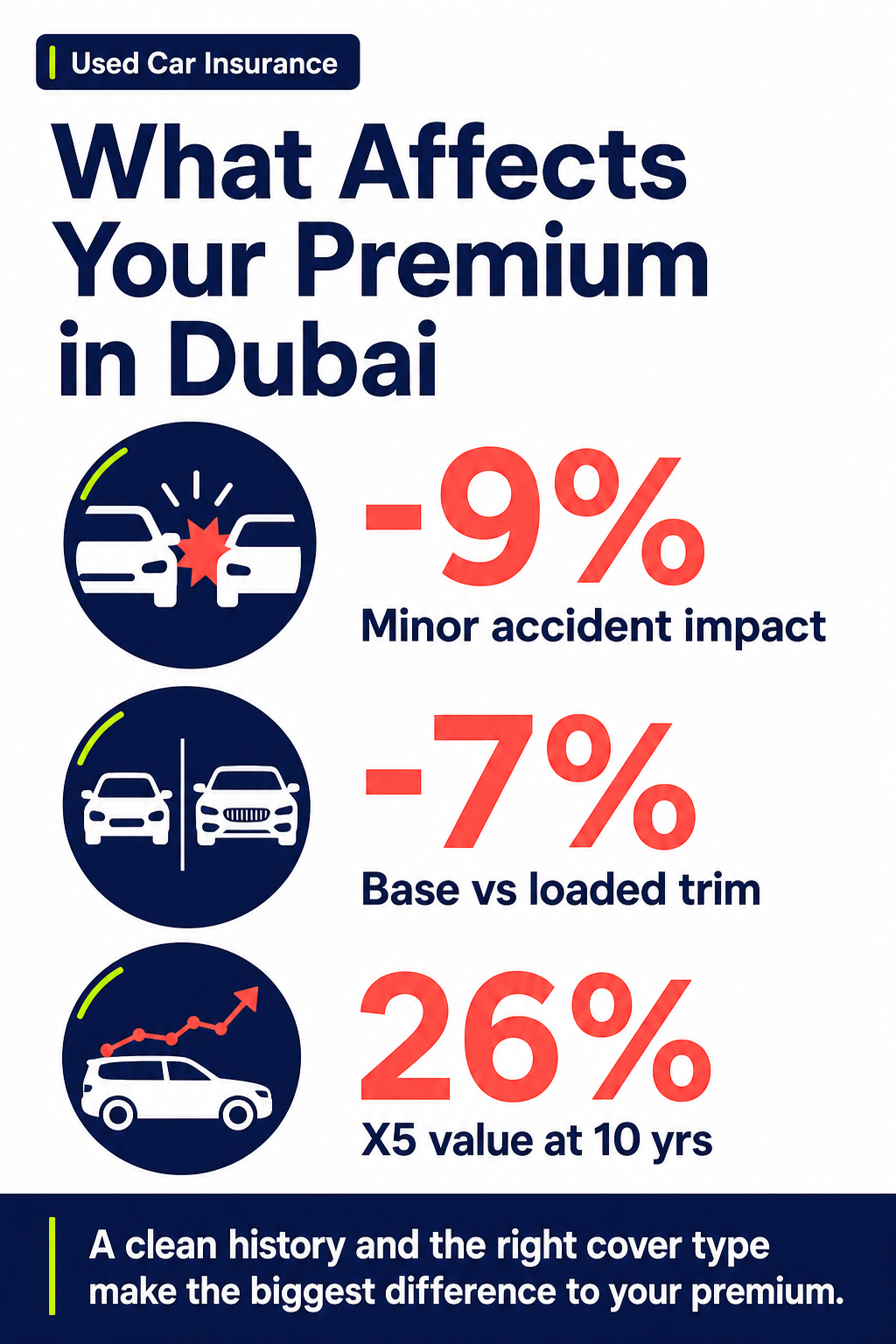
Across CarSwitch listings data (July 2026), cars with a minor accident on record sell for about 9% less than identical cars with no accident history. That’s a real gap. On a car listed around AED 100,000, that’s roughly AED 8,500 less in value — and your insurer uses that lower figure to calculate your premium and your maximum payout.
“Buyers ask about accident history before anything else. Insurers think the same way — a clean record on the inspection report keeps your insured value closer to what the car is actually worth.”
Kamel Abbou, Country Manager, UAE, at CarSwitch
Cars with a major accident history show a smaller price gap (around 5% in our data), but that’s partly because fewer of them trade hands — insurers may also flag them for a physical survey before quoting.
Age matters too
The older the car, the less it’s worth to insure. A six-year-old BMW X5 still holds about 73% of a one-year-old example’s value. By ten years old, that drops to around 26%. Insurers use the current market value, so older cars naturally carry lower premiums — but also lower payouts if something goes wrong.
| Factor | Value retained / Price impact | What it means for insurance |
|---|---|---|
| No accident history | 0% (baseline) | Higher insured value, higher premium, higher payout |
| Minor accident history | -9% vs clean | Lower insured value, lower premium, lower payout |
| BMW X5 at 6 years old | 73% of 1-year value | Still worth insuring comprehensively |
| BMW X5 at 10 years old | 26% of 1-year value | Third-party may be enough |
| Base trim vs fully loaded | -7% | Trim level affects the insured value your insurer assigns |
Trim level plays a role too. A base-spec car is worth about 7% less than a fully loaded version of the same model. Make sure your insurer knows exactly which spec you have — overvaluing means overpaying on premiums, undervaluing means a smaller payout.
Minor accident history = 9% lower resale value vs clean history (n=250+)
BMW X5 at 6 years: retains 73% of value | at 10 years: retains 26%
Base trim vs fully loaded: 7% price gap
Documents you need to insure a used car in Dubai
This part is straightforward. Have these ready before you request quotes:
- Emirates ID — valid, not expired.
- UAE driving licence — your Dubai or Abu Dhabi licence works nationwide.
- Vehicle registration card (Mulkiya) — shows ownership and car details.
- Previous insurance policy — if you’re switching. Proves your no-claims record.
- Vehicle condition report — not required by every insurer, but an inspection-verified report from a trusted source can speed up the process and sometimes improve your rate.
If you’re buying the car through car installments, your financing provider will usually require comprehensive cover. The bank is listed as a “loss payee” on the policy — meaning they get paid first if the car is totalled.
Five ways to pay less
1. Build no-claims years. Every claim-free year earns you a discount. After two or three years, this can knock 15–25% off your premium.
2. Increase your voluntary excess. Agree to pay more out of pocket per claim, and your annual premium drops. A voluntary excess of AED 1,000–1,500 makes a noticeable difference.
3. Compare at least three insurers. Rates vary more than you’d expect. Use a broker or comparison site — or call directly. The same car can be quoted with a 30–40% spread between insurers.
4. Ask your bank. If you’re financing the car, your bank often has a tied insurance partner. Bundled rates aren’t automatically the lowest, but they’re worth getting on paper before you decide.
5. Buy a car with a clean history. This one works before you even own the car. A clean accident record means a higher insured value and a stronger claim if anything happens. When you’re browsing used cars in Dubai, filter for inspection-verified cars — you’ll know exactly what you’re insuring.
The step-by-step process
- Decide between comprehensive and third-party cover.
- Gather your Emirates ID, licence, and Mulkiya.
- Get quotes from three or more insurers — online, through a broker, or by phone.
- Check what’s included: agency repair vs non-agency, roadside assistance, off-road cover, personal accident.
- Pay and receive your policy. Most insurers issue it digitally within a few hours.
- Keep a copy in your car and on your phone. You’ll need it for RTA registration renewal.
No complicated steps. It’s that smooth.
Start with a car you can trust
Insurance is smoother when you know exactly what you’re covering. Every car on CarSwitch comes with a detailed inspection report — accident history, condition, specs — so you and your insurer are working from the same facts. Browse 2,400+ inspection-verified used cars in Dubai and find your next car with no hidden surprises.
Yes. Every car driven on UAE roads must have at least third-party insurance. You cannot register or renew your vehicle without a valid policy.
A car with a minor accident on record is worth roughly 9% less than an identical car with a clean history, based on CarSwitch data. Insurers use this lower market value to set your premium and your maximum payout — so you pay less, but you’re also covered for less.
If your car is still worth a meaningful amount — say over AED 50,000 — comprehensive cover is usually worth it. For older, lower-value cars, third-party may be enough since the premium for comprehensive cover can approach what the car itself is worth.
You need your Emirates ID, UAE driving licence, and vehicle registration card (Mulkiya). If you’re switching insurers, bring your previous policy to prove your no-claims history.
