

Get Your Car Desert-Ready Before October
October is a week away, the temperature is dropping, and every SUV owner in the UAE is about to head for the dunes. Here’s what to do right now: check your tyres, top up your coolant, inspect the underbody, and pack recovery gear. If you don’t own an SUV yet, this is actually a great time to pick one up — SUVs make up about 63% of all cars in UAE listed on CarSwitch (CarSwitch listings data, July 2026), which means there’s plenty of choice and real room to find fair value.
The short version
- Deflate tyres to around 15–18 psi for soft sand — but carry a portable compressor to re-inflate for road driving.
- Have your coolant system checked now; a summer-cooked engine doesn’t need an October desert push without fresh fluid.
- Get the underbody inspected for cracked skid plates, loose heat shields, and dried-out CV boots.
- Pack a recovery kit: tow strap, shackles, shovel, tyre deflator, compressor — non-negotiable.
- SUVs are oversupplied on CarSwitch right now — a used Wrangler or Patrol can save you 40–60% versus buying new.
Tyres: the single thing that decides if you get stuck
Sand driving is all about surface area. You need to air down your tyres before you leave the road. Most experienced desert drivers drop to 15–18 psi on soft sand. That widens the tyre’s footprint and keeps you floating instead of digging in.
Before you go, check tread depth and sidewall condition. Summer heat in the UAE destroys rubber. If your tyres are older than four years or the tread is below 3 mm, replace them. All-terrain tyres (marked A/T on the sidewall) are the sweet spot — good enough on tarmac, grippy enough off it.
Carry a portable 12V compressor. You’ll need to re-inflate before driving back on the highway. Without one, you’re stuck at a petrol station — or worse, driving home on soft tyres at speed.
Coolant and fluids: your engine survived summer, but barely
Five months of 45°C-plus driving takes a toll on coolant. By October, the fluid in most cars in UAE has been working harder than it was designed to. Get it tested or just flush and replace it. A coolant failure in the desert — far from help — is a tow bill you don’t want.
While you’re at it, check your power-steering fluid, brake fluid, and transmission fluid. Desert driving puts extra stress on all of them, especially if you’re crawling through dunes at low speed in low-range gears.
Underbody check: what the sand hits first
Before your first trip, get underneath the car — or have a workshop do it. Here’s what to look for:
- Skid plates: cracked or missing? Replace them. They protect the sump, transfer case, and fuel tank.
- CV boots: rubber boots over the axle joints dry out in UAE heat. A split boot lets sand in, and sand kills the joint fast.
- Heat shields: loose shields rattle and can catch on rocks or sand ridges. Tighten or remove them.
- Exhaust hangers: a low-hanging exhaust is the first casualty on a dune approach.
If you’re buying an inspection-verified car through CarSwitch, the 200-point inspection already covers underbody condition. That gives you a head start — you’ll know exactly what’s been flagged before you commit.
Recovery gear: pack it or don’t go
No matter how good your SUV is, you will get stuck. It’s part of desert driving. The question is whether you can get out in ten minutes or three hours. Here’s the minimum kit:
- Kinetic recovery strap (rated to your vehicle’s weight — at least 8,000 kg for a full-size SUV).
- Two rated bow shackles — never use hooks; they can fly off under load.
- A shovel — compact and metal-bladed.
- Tyre deflator and compressor — as mentioned above.
- Traction boards (like MaxTrax) — optional but worth the boot space.
And bring water. More than you think you need. Desert trips go wrong when people underestimate distance from the nearest road.
Don’t have an SUV yet? Now is actually a smart time to buy
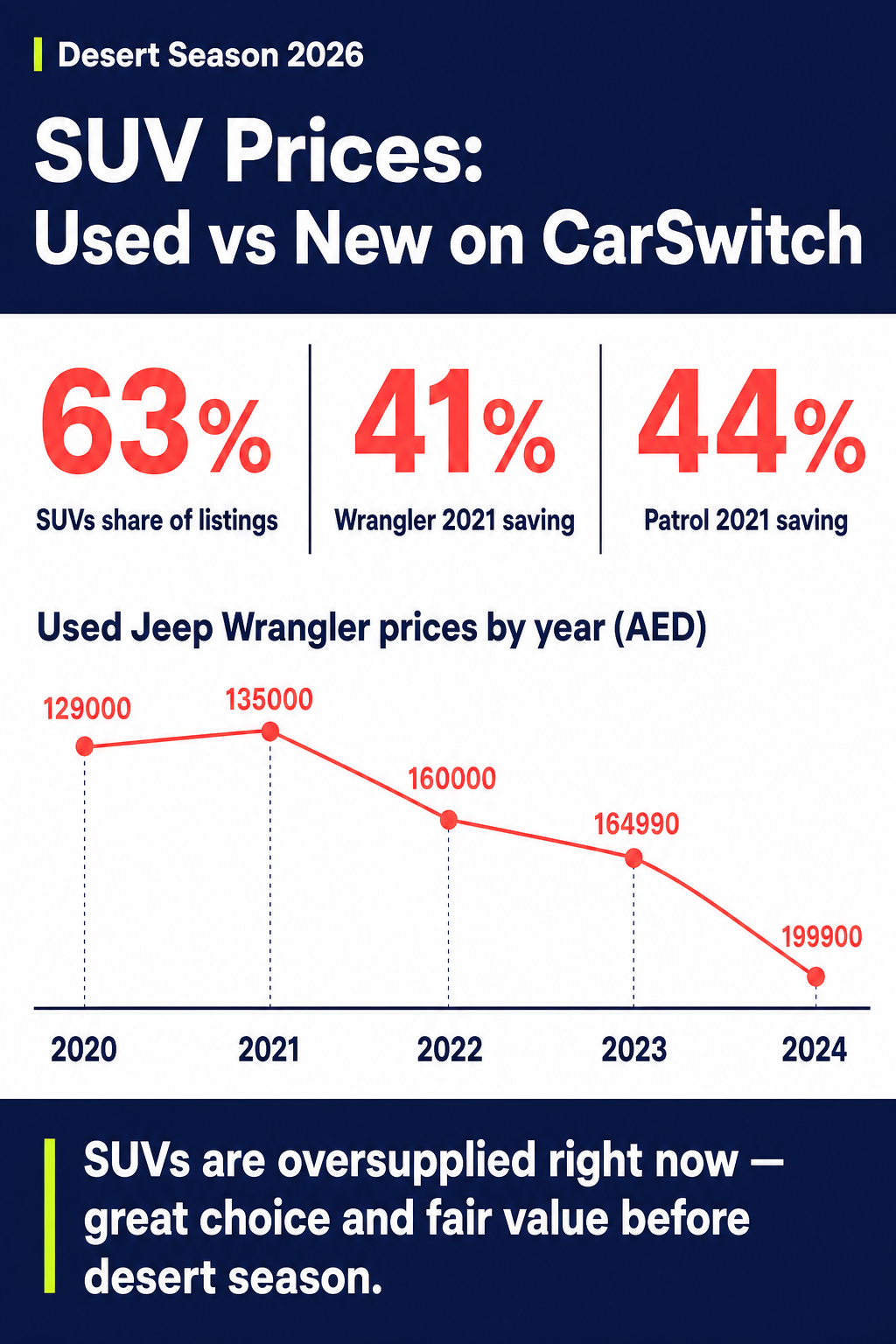
Right now, SUVs are the most oversupplied body type on CarSwitch. About 63% of all listings are SUVs — that’s nearly two out of every three cars on the platform. More supply means more choice and more room to find a fair price.
Two of the most popular desert-capable SUVs — the Jeep Wrangler and Nissan Patrol — are well represented. A 2021 Wrangler lists for around AED 135,000, which is roughly 41% less than buying one new. A Patrol from 2021 sits around AED 180,000 — about 44% off new price.
| Model | Year | Listed price (AED) | New price (AED) | Saving vs new |
|---|---|---|---|---|
| Jeep Wrangler | 2020 | 129,000 | 227,900 | 43% |
| Jeep Wrangler | 2021 | 135,000 | 227,900 | 41% |
| Jeep Wrangler | 2022 | 160,000 | 227,900 | 30% |
| Nissan Patrol | 2020 | 146,995 | 322,900 | 55% |
| Nissan Patrol | 2021 | 179,990 | 322,900 | 44% |
The Wrangler also holds its value well. A three-year-old one is still worth about 83% of a one-year-old example. That’s strong for an SUV — and it means your desert toy won’t lose you a fortune if you sell it in a couple of years.
“SUVs are the backbone of the used car market here. When supply is this high, buyers get real choice — you’re not settling, you’re picking.”
Ramiz Islam, Head of Marketing at CarSwitch
SUVs make up 63% of all UAE listings — the largest body type by far.
A 2021 Jeep Wrangler lists for AED 135,000 — 41% less than new.
A 2021 Nissan Patrol lists for AED 179,990 — 44% less than new.
Where to look in the UAE
Most of our SUV listings — and most of our sales — happen in Dubai. If you’re in Abu Dhabi or Sharjah, you’ll find options at every price point too. Browse from the app, and real people on the CarSwitch support team can help you narrow things down. Every car is inspection-verified before it’s listed, so you’re not gambling on hidden problems.
A quick pre-trip checklist
- Tyres: tread above 3 mm, sidewalls in good shape, A/T preferred.
- Coolant: flushed and fresh.
- Underbody: skid plates intact, CV boots sealed, nothing hanging loose.
- Recovery kit: strap, shackles, shovel, compressor, boards.
- Water: at least 5 litres per person, plus extra for the radiator.
- Travel in a group. At least two vehicles. Non-negotiable for remote dunes.
If you’re still looking for the right SUV to take out this season, browse Nissan Patrols or check out rugged options like the Toyota Fortuner on CarSwitch. Every listing is inspection-verified, pricing is transparent, and real people are here to help you through the process — smoothly done, from browsing to buying.
Most experienced drivers deflate to around 15–18 psi for soft sand. This widens the tyre’s contact patch so you float instead of digging in. Carry a portable compressor to re-inflate before driving back on the highway.
SUVs make up about 63% of CarSwitch listings right now, so there’s plenty of supply and strong choice. A 2021 Jeep Wrangler, for example, lists for around AED 135,000 — roughly 41% less than new.
At minimum: a kinetic recovery strap rated to your vehicle’s weight, two bow shackles, a metal-bladed shovel, a tyre deflator, and a 12V compressor. Traction boards are a smart addition too.
Start with coolant — after a UAE summer, it’s likely degraded. Also check power-steering fluid, brake fluid, and transmission fluid. Desert driving at low speeds and in low range puts extra load on all of them.
